Need a refresher on your scissor lift terms? Did a coworker use a phrase you didn’t understand, and you were too afraid to ask what it meant? We’ve got your back. One quick read through this blog and you’ll have all the fancy terms and slang you need to impress your boss.
| ANSI | The American National Standards Institute. This organization creates standards for manufacturing equipment, including mobile elevating work platforms (MEWPs). The most recent standard, A92.20, was put into effect in June of 2020, enacting several design requirements that caused a shift in the lift industry. |
| Cantilever | System used on scissor lift platforms to float the entry gate above debris and prevent jamming. |
| Floor Load | Also called ground pressure, this is the amount of force a floor can withstand or the amount of pressure a machine exerts on the floor. This is not only relative to machine weight, but also the occupied floor area. |
| Folding Rails | As a result of the 2020 ANSI standard updates, the minimum rail height on scissor lifts was raised to 43.3 in. This change caused many scissor lift manufacturers to place folding rails on their 19 ft models. These rails must be folded down using pins or levers to make the machine short enough to fit through a standard doorframe. |
| Hybrid | Scissor lifts that combine hydraulic and electric components. Hy-Brid Lifts was one of the first to bring this style of machine to the market, replacing traditional all-hydraulic machines. Many hybrid machines feature electric drive and steer with hydraulic lifting. |
| Lift Diaper | A protective cloth placed around the underside of a scissor lift to prevent leaked hydraulic fluid from damaging the floor below. Many manufacturers provide leak protection systems to prevent leaks entirely and eliminate the need for diapers. |
| Load Sensing | Scissor lifts are required to feature load-sensing and prevent elevation if the rated capacity is exceeded. Hy-Brid Lifts are equipped with active load-sensing to keep workers informed by displaying the percentage of capacity used. |
| MEWP | Mobile elevating work platform. With the updated standard, this term has become the industry norm machines including scissor lifts, boom lifts, and mast lifts. Before 2020, these lifts were referred to as AWPs, or aerial work platforms. |
| Rough Terrain Scissor Lift | These scissor lifts are built for outdoor usage on uneven surfaces. They feature larger tires, oscillating axles, and diesel engines. They are much heavier than slab scissor lifts, but have greater platform capacities to lift more workers, tools, and materials. |
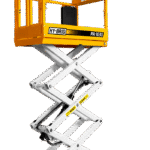
| Slab Scissor Lift | Smaller and lighter than rough terrain lifts, slab scissors are meant for indoor applications on flat surfaces. They are designed to be compact and lightweight to move freely throughout an indoor jobsite, which features many obstacles and sensitive flooring. |
| Step-In Height | The distance from the ground to the platform when a lift is in the stowed position. Some lifts require multiple steps to enter the platform, while others are built with a compact design to make access easier. |
| Zero-Turn Radius | Lifts that complete a turn with a zero-inch turn radius, allowing for increased maneuverability as they do not need to take a wide loop to change directions. Some lifts, like the Zero-Turn Series, have a less-than-zero degree turn radius for unprecedented maneuverability. |
And there you have it, now you know almost everything there is to know about scissor lifts. To stay in the know on all industry and product changes, follow Hy-Brid Lifts on LinkedIn.